Skip to content

Spatial Dimensions is a UK measured building survey and geospatial company carrying out CCTV drainage surveys as part of our underground utility surveys. Established in 2012, we work nationwide from permanent offices in London, Sevenoaks and Nottingham, and mobilise to site in an average of 5.3 working days from instruction.
Our drainage investigation teams send robotic, non-man-entry camera units through your drainage runs to record what is down there, what condition it is in, and how it all connects — without anyone entering a chamber.
In short: a CCTV drainage survey from Spatial Dimensions identifies and maps your below-ground drainage system to the WRc standard for non-man-entry sewer inspection. You receive recorded footage, a condition report and, where we have also carried out a topographical survey, the drainage plotted accurately onto your site drawing. Surveys start at £900 per day on site.
or call 01732 458799

What is a CCTV drainage survey?
A CCTV drainage survey puts a remotely operated camera through underground drainage pipework to identify and map the system from the inside. It answers two questions that records and surface surveys cannot fully answer: what condition each run is in, and how the runs actually connect.
“Non-man-entry” means exactly what it says — nobody enters the drains or chambers. The camera does the travelling, and our surveyors work from ground level. Alongside the camera, Spatial Dimensions uses electronic tracing equipment, which follows a transmitter signal in the pipe from the surface so each run can be plotted in its true position on the drawing, not sketched from assumption.
The results are used to plan repairs, confirm connectivity before drainage designs are finalised, and complete the picture where statutory records are thin.
What standard do CCTV drainage surveys follow?
Spatial Dimensions carries out CCTV drainage surveys to the WRc Model Contract Document for non-man-entry sewer inspection — the recognised UK standard for this type of work, published by WRc, the water industry research body. Working to it means the inspection and reporting follow a defined, checkable specification.
All work complies with the Health and Safety at Work Act 1974 and the Confined Spaces Regulations 1997. Our field staff are confined-space trained, we issue site-specific risk assessments and method statements (RAMS) before mobilising, and the company carries £10 million each of professional indemnity, public liability and employers liability insurance.
How does Spatial Dimensions carry out a CCTV drainage survey?
Our drainage investigation teams arrive self-sufficient: CCTV survey and electronic tracing equipment, all manhole lifting tools, and the PPE the work requires. Two practical site resources — parking for the survey vehicle and a water supply — are factored into the plan at quotation stage.
The approach is customised to each site. Before the camera goes in, the team establishes the flow and silt levels in the system, because both determine how much the camera can usefully see. Surveys run during standard business hours; night and weekend working, or any need for special lifting tools, is flagged to you promptly and quoted separately.
Two site rules worth knowing in advance:
- Cover lifting. We allow a maximum of 30 minutes per inspection cover using a hand-operated hydraulic lifter. If a cover will not lift safely — or cannot be safely re-seated — it is recorded as “Unable to Lift” (UTL) rather than forced and damaged.
- Chamber classification. Quotes assume all chambers are NC1 low-risk confined spaces under the Water UK national classification. Chambers classified NC2 or above need extra resources and are charged extra, always with advance notice.
What can a CCTV drainage survey not tell you?
Spatial Dimensions would rather set the limits out before you commission the survey than explain them afterwards.
- Silted, blocked or surcharged drainage gives incomplete information. A surcharged pipe is one running full of backed-up water — the camera cannot see through silt or standing water.
- Jetting is not standard. High-pressure water jetting to clear runs before inspection is an additional cost, arranged when the system needs it.
- Pumped or sealed drainage pipes can be hard to detect, depending on their material and size.
- Chamber measurements are indicative. Because nobody enters the chambers, tape measurements are taken from ground level, and fast-flowing water limits what can be measured.
- Runs without probe access are excluded. Drainage with no access point for a camera or transmitter probe cannot be surveyed.
As with all sub-surface work, results should be independently verified before construction designs or excavation rely on them.
What will I receive?
Swipe the table sideways to see all the columns.
| Deliverable | What it is |
|---|---|
| CCTV condition report | Report to the WRc non-man-entry standard, with recorded footage, condition grading and clear recommendations |
| Drainage mapping | Runs, chambers and connectivity plotted onto your topographical survey base — or delivered in 3D where specified |
| Invert levels, runs and pipe diameters | Available on request as part of a Spatial Dimensions topographical survey; an invert level is the level of the channel at the bottom of the pipe |
All processing and drafting is done in-house — never outsourced — and every deliverable passes multi-stage checking under our ISO 9001:2015 quality system.

How does a CCTV survey fit with the other utility surveys?
CCTV is the inside-the-pipe stage of a wider utility investigation, and the stages run in a deliberate order.
- Topographical survey first — the base drawing, and the count of manhole covers a CCTV quote is priced from.
- Desktop utility search — statutory records collated onto one drawing; recommended on every project (interim report in 3–5 working days).
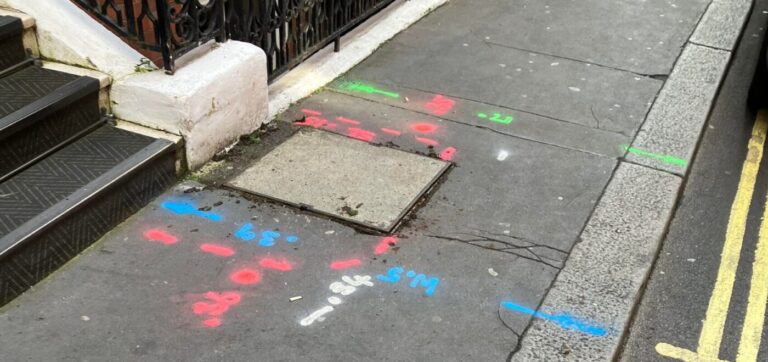
- Electromagnetic location survey — EML and GPR detection traces buried services, including drainage accessible from manholes, from the surface.
- CCTV drainage survey — the camera goes inside the drainage itself for condition and connectivity, which surface detection cannot provide.
- Utility verification survey — physical confirmation by vacuum excavation where the design demands certainty.
The stages run consecutively and may need more than one visit; if you have a deadline, tell us at enquiry stage and we will plan around it.
Who commissions CCTV drainage surveys?
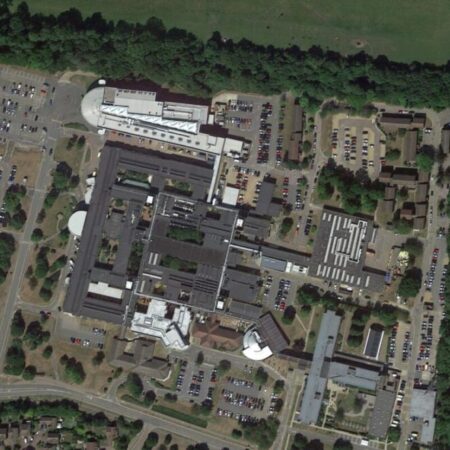
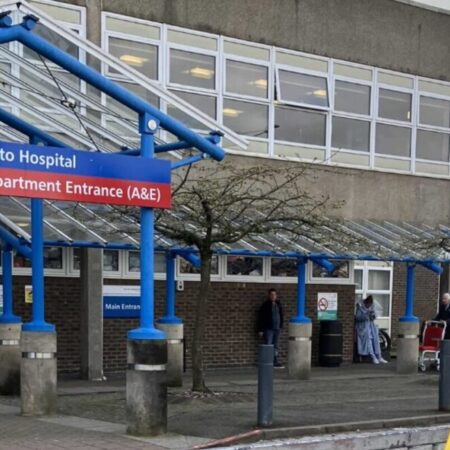
Contractors planning below-ground works, architects and drainage designers confirming connectivity, consultants and project managers assembling due-diligence information, and estates teams maintaining large sites. Spatial Dimensions has delivered CCTV drainage reports on projects including Basildon University Hospital, Kent & Canterbury Hospital, Canterbury College and St Michael’s School (Ty Mawr).
If that sounds like your role, our resource pages for contractors, architects and consultants explain how we work with each.
How much does a CCTV drainage survey cost?
A CCTV drainage survey from Spatial Dimensions starts at £900 per day on site. Most CCTV drainage surveys fall between £1,000 and £3,500 in total, depending on the number of chambers and their condition.
A CCTV drainage survey is priced on the number of manhole covers identified — which is why it is best quoted after a topographical survey has counted the site’s chambers. Other factors that move the price: site access, chamber classification (NC1 assumed; NC2 and above cost more), whether traffic management is needed, the condition of the system, and whether jetting is required to clear runs first.
Estimated costs exclude night and weekend working, traffic management, access arrangements on private land, and dealing with blocked or damaged drainage — each quoted separately. Spatial Dimensions quotes fixed prices against a written specification, so you know what is included before work starts.
For a fixed price, send us the site address and the chamber count if you have it. We will come back with a written quote within 24 hours. All prices exclude VAT.
or call 01732 458799
Frequently asked questions
What is a CCTV drainage survey?
A remotely operated, non-man-entry camera is sent through your drainage runs to identify and map the system — its condition and its connectivity — reported to the WRc standard. Nobody enters the pipes or chambers.
Do you jet the drains before surveying?
Not as standard. High-pressure jetting is an additional cost, arranged when silt or blockages would otherwise stop the camera seeing the pipe.
Can you survey blocked drains?
Only partially, and Spatial Dimensions says so plainly: silted, blocked or surcharged drainage gives incomplete information because the camera cannot see through silt or standing water. Clearing the blockage first — by jetting or repair — is what makes a full survey possible.
Do your surveyors enter the drainage chambers?
No. The survey is non-man-entry throughout: the camera travels the pipes and all measurements at chambers are taken from ground level, which is why chamber tape measurements are indicative rather than exact.
What happens if a manhole cover cannot be lifted?
Spatial Dimensions attempts each cover for a maximum of 30 minutes with a hand-operated hydraulic lifter. If it will not lift safely, or cannot be safely re-seated, it is recorded as “Unable to Lift” (UTL) and reported — we do not force covers.
How is a CCTV drainage survey priced?
On the number of manhole covers identified, which is why Spatial Dimensions quotes CCTV after the topographical survey has counted the chambers. Quotes assume NC1 low-risk chambers and standard business hours; anything beyond that is priced separately with notice.
What standard do you work to?
The WRc Model Contract Document for non-man-entry sewer inspection, with full compliance with the Health and Safety at Work Act 1974 and the Confined Spaces Regulations 1997. Our Guide to Specifying an Underground Utilities Survey is free to download from our guides page.
Request a CCTV drainage survey quote
Send us the site address, the chamber count if you have it, and what the survey is for; Spatial Dimensions will reply with a written, fixed-price quote within 24 hours.
Phone: 01732 458799
Offices: London · Sevenoaks · Nottingham · working nationwide
Related services
- Underground utility surveys — the parent service and PAS 128 quality levels
- Desktop utility searches — statutory records, the QL-D stage
- Electromagnetic location surveys — surface detection of buried services
- Utility verification surveys — physical confirmation by trial hole
- Topographical surveys — the base survey a CCTV quote is priced from